Do You Really Need to Pay to Get an EIN? (The Honest Answer Most Sites Avoid)
Blog post description.
2/8/20263 min read
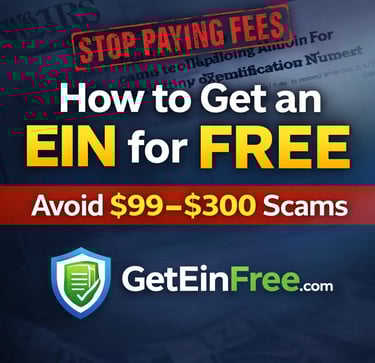

Do You Really Need to Pay to Get an EIN? (The Honest Answer Most Sites Avoid)
If you’ve searched online for an EIN, you’ve seen the same pattern everywhere.
Big buttons.
Urgent language.
“IRS filing service.”
$99. $149. $299.
And always the same implication:
“You can’t really do this yourself.”
That implication is false.
But the truth is more nuanced than “never pay” or “always pay.”
This article gives you the honest, complete answer—so you can decide calmly, legally, and without wasting money.
The Short Answer (Before We Go Deep)
Yes, you can get an EIN for free directly from the IRS.
No, you are not required to pay anyone.
But some people still pay—not because it’s required, but because they’re confused, rushed, or misled.
Understanding why that happens is the key to not being one of them.
Why So Many Websites Say You Must Pay
Let’s be clear.
Websites that charge for EINs are not:
IRS partners
official intermediaries
required services
They are marketing businesses.
Their entire model depends on making a free process feel:
complicated
risky
urgent
Fear sells faster than clarity.
What the IRS Actually Says About EINs
The IRS position is unambiguous:
EINs are issued free of charge
There is one official application
No third party is required
If a site charges you, you are paying for:
form completion
submission assistance
hand-holding
Not for the EIN itself.
The Psychological Trap That Gets People to Pay
Most people don’t pay because they can’t do it.
They pay because:
they’re afraid of making a mistake
they’re under time pressure
they assume “official-looking” means official
Paid sites exploit uncertainty—not complexity.
How Paid EIN Services Frame the Problem
Notice the language they use:
“Avoid delays”
“Prevent IRS rejection”
“Secure your EIN today”
This implies:
the IRS rejects many applications (it doesn’t)
mistakes are costly (they usually aren’t)
urgency exists (it usually doesn’t)
The framing is designed to override calm decision-making.
What Actually Happens If You Make a Mistake Yourself
This is what most people fear—and misunderstand.
If you:
select the wrong option
misunderstand a field
apply too early
The outcome is usually:
clarification
a fix
a wait
Not fines.
Not penalties.
Not blacklisting.
Mistakes are fixable. Panic is expensive.
Who Never Needs to Pay for an EIN
You almost certainly don’t need to pay if you are:
a sole proprietor
forming a standard LLC
starting a small online business
a non-US founder applying correctly
not under extreme time pressure
These cases represent the majority of EIN applicants.
When Paying Is Still Not Required—but Sometimes Chosen
There are edge situations where people choose to pay:
they don’t speak English well
they are delegating everything
they want zero involvement
Even then, it’s a convenience decision, not a requirement.
And convenience should never be confused with obligation.
The Biggest Lie: “We Apply Faster Than the IRS”
No third party can:
speed up the IRS system
bypass queues
get priority EINs
All applications go through the same process.
Anyone claiming speed advantage is selling fiction.
Why Non-US Founders Are Targeted the Most
Non-US founders are told:
“You can’t do this yourself.”
That’s false.
Non-US founders:
can apply
can get EINs
do not need SSNs
The process is slightly different—but fully legitimate.
Fear-based marketing targets international founders aggressively.
The Cost of Paying Isn’t Just Money
The hidden cost is:
loss of understanding
dependency on intermediaries
confusion later when issues arise
When something goes wrong, paid services disappear.
Understanding your EIN yourself gives you control.
Why “Free” Guides Online Still Push Paid Services
Many “free” articles are:
affiliate content
lead funnels
disguised ads
They answer the question just enough to scare you.
Real clarity removes the need to pay—and removes their revenue.
The Real Question You Should Ask Instead
Not:
“Should I pay?”
But:
“Do I understand what I’m doing?”
If the answer is yes, paying makes no sense.
If the answer is no, the solution is understanding, not outsourcing blindly.
How to Know If a Site Is Not the IRS (Fast)
Red flags:
prices on the page
words like “partner” or “filing service”
urgency timers
multiple upsells
The real IRS site:
doesn’t sell
doesn’t rush
doesn’t upsell
Clarity beats marketing.
Why People Regret Paying Later
After paying, people realize:
the EIN arrived instantly anyway
nothing special was done
they could have done it themselves
Regret doesn’t come from paying.
It comes from realizing it was unnecessary.
The Calm Way to Decide
Before paying anyone, pause and ask:
Am I legally required to pay? (No)
Is this complex, or just unfamiliar?
Would 30 minutes of clarity save $150?
Most of the time, the answer is obvious once fear is removed.
What This Guide Is Actually For
This guide exists because:
people are tired of being misled
fear-based marketing is everywhere
clarity is rare
Understanding the process once saves you:
money
stress
future mistakes
The Honest Bottom Line
You do not need to pay to get an EIN.
You do not need an “IRS partner.”
You do not need to rush.
You need:
clarity
correct timing
calm execution
That’s it.
👉 If you want a clear, step-by-step explanation of how to get your EIN for free, avoid scams, handle edge cases, and know exactly what to do in every situation, the complete EIN Guide walks you through the entire process calmly and legally—without paying a cent to unnecessary services.https://geteinfree.com/how-to-get-an-ein-for-free-guide
Help
Clear steps to get your EIN free
Contact
infoebookusa@aol.com
© 2026. All rights reserved.